Future-Proof Your Website: Getting Ahead of the AI Search Curve
Search is transforming faster than ever before. Traditional search engines like Google and Bing are being complemented—and in many cases, replaced—by AI-powered alternatives like ChatGPT, Claude, Perplexity, and specialized AI tools. Today, AI-driven search is becoming the dominant way users discover products, services, and events online.
The AI Search Revolution is Here
The stakes are clear: websites that optimize for AI search now will capture market share from competitors still focused exclusively on traditional SEO. The question isn’t whether AI search matters—it’s whether your website is ready for it.
Understanding GEO: How LLMs Read Your Website
To compete in the age of AI search, you need to understand how large language models (LLMs) actually read and interpret your website. This is where GEO (Generative Engine Optimization) comes in.
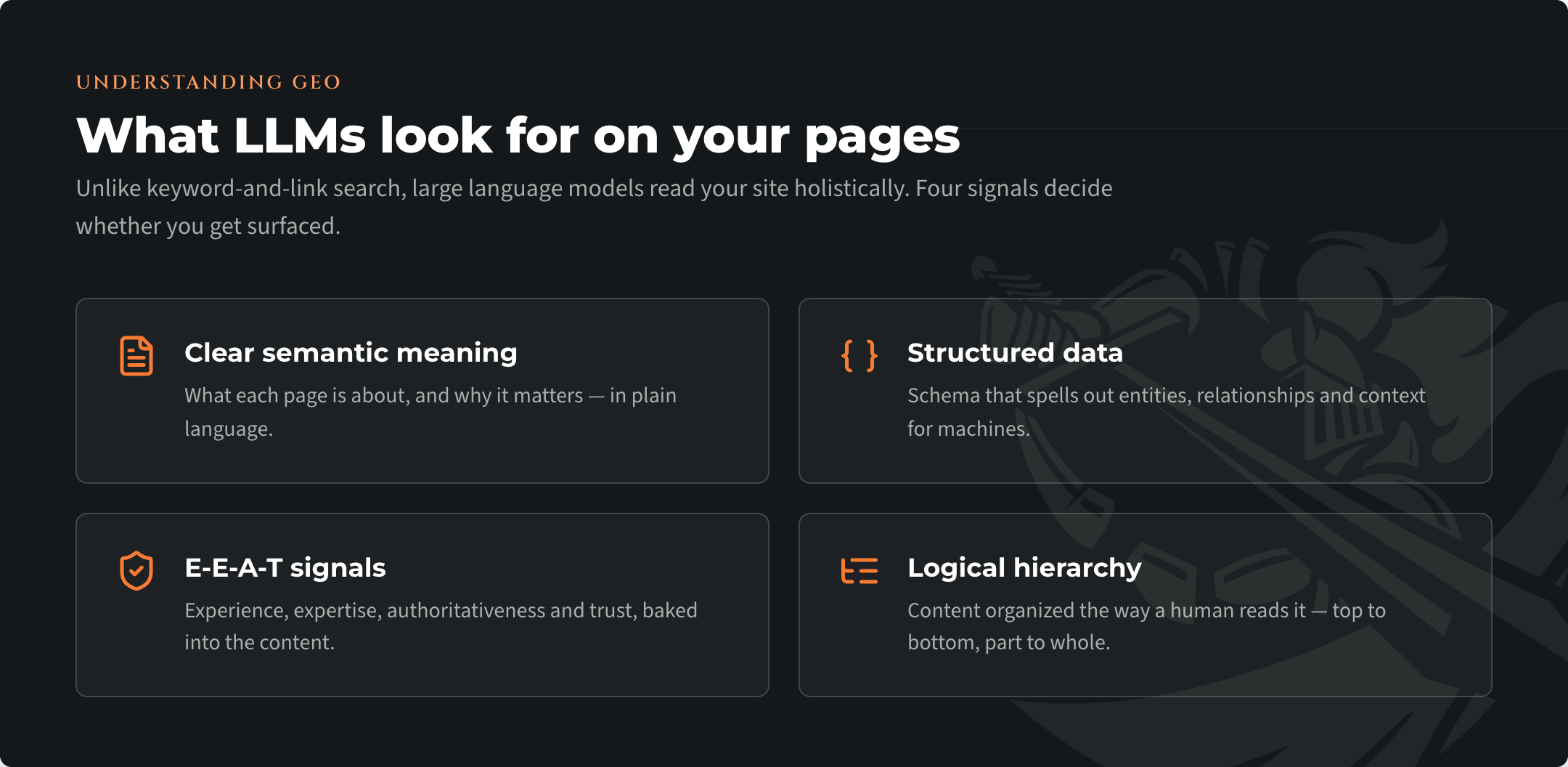
- Clear, semantic meaning in your copy—what your pages are about and why they matter
- Structured data that helps machines understand relationships, entities, and context
- E-E-A-T signals (Experience, Expertise, Authoritativeness, Trustworthiness) embedded in your content
- Logical content hierarchy and organization that mimics human reading patterns
How structured data supports search visibility
Structured data helps search engines identify page types, authors, events, products, organizations, and other entities. It can make content eligible for certain enhanced search features, but it does not guarantee inclusion in AI-generated answers. Crawlability, indexing, relevant content, internal links, and credible evidence remain the foundation.
Without structured data, an LLM has to guess at your meaning. With it, you’re providing a clear roadmap. This matters enormously because:
- LLMs use structured data to extract authoritative answers – When an AI chatbot is asked “What events are happening in the BVI this weekend?”, it looks for properly formatted event schema to surface relevant results.
- Structured data improves context understanding – Schema markup helps LLMs understand relationships: who wrote an article, when it was published, what organization authored it, and how authoritative that source is.
- Ranking in AI answers requires discoverability – If your content isn’t properly marked up, AI tools may never crawl or recognize it as a trustworthy answer source, no matter how good your content is.
Websites that combine high-quality, semantic content with comprehensive structured data see dramatically better visibility in both traditional search results and AI-powered answer engines.

Real Results: Proven Growth from SEO & GEO Optimization
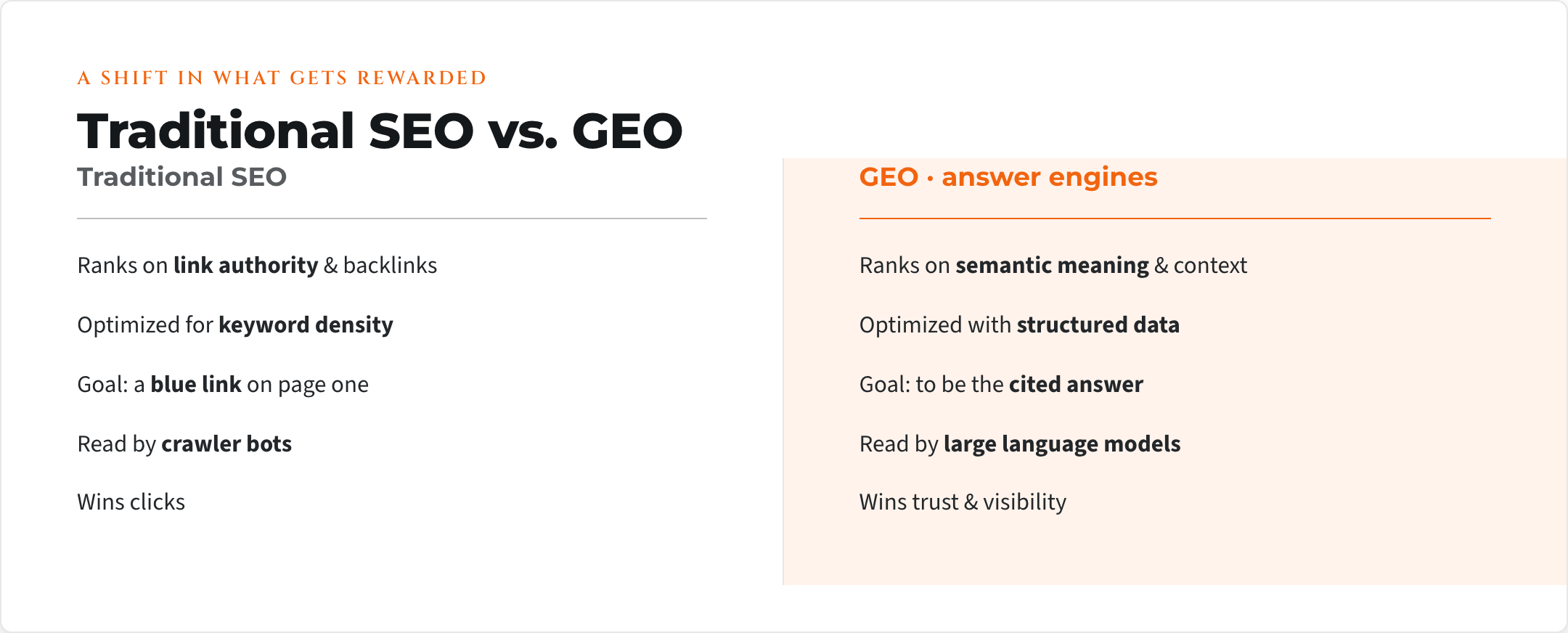
Unlike traditional search engines that rely on link authority and keyword density, LLMs analyze website content holistically. They look for:
This approach isn’t theoretical—it’s delivering measurable results for real businesses.
Client A: 416% Growth in Impressions
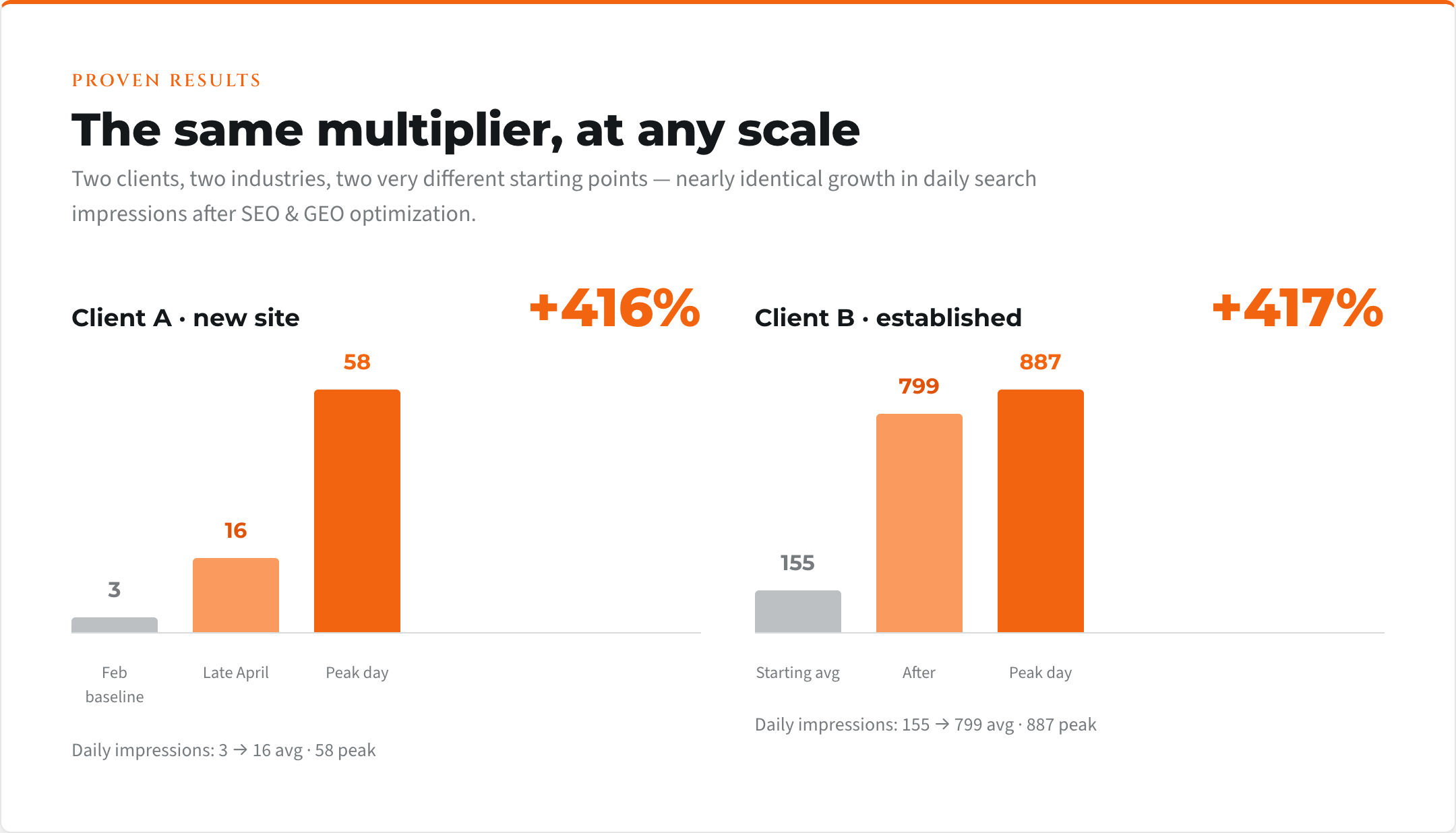
For a client with a newly redesigned website, we implemented comprehensive SEO and GEO optimizations, including structured data, improved content hierarchy, and enhanced semantic clarity. The results:
- February baseline: 3 daily impressions (average)
- Late April: 16 daily impressions (average)
- Peak single day: 58 impressions
- Total growth: 416% increase in daily visibility
Client B: Matching Results, Different Scale
We undertook similar optimizations for a second client and achieved nearly identical growth despite a completely different starting point:
- Starting average: 155 daily impressions
- After optimization: 799 daily impressions (average)
- Peak single day: 887 impressions
- Total growth: 417% increase in daily impressions
What This Means
Both clients achieved virtually identical growth rates (416% vs. 417%) despite vastly different websites and industries. This consistency points to a fundamental truth: optimizing for both traditional SEO and AI search (GEO) is a scalable, predictable strategy. Whether you’re starting with 3 impressions or 155, the multiplication effect is the same.
The Time to Act is Now
As AI-powered search becomes the default way users find information, websites that optimize early will capture disproportionate visibility. Those that ignore this shift risk becoming invisible to a growing segment of searchers.
Ready to future-proof your website? Let’s talk about how SEO and GEO optimization can deliver the growth you’ve seen from our other clients.
Read more on this topic: